
outblasted
New member
- Joined
- Jul 27, 2015
- Location
- Sunnyvale
- Moto(s)
- 19' Yamaha R6;
06' Yamaha R6 (sold);
13' Ninja 300 (RIP)
(Alright, this turned out to be a bit longer that what I planned)
I was traveling northbound on CA35, not far from CA9 (google maps link)... Lovely Sunday morning... First time on this road.
After negotiating a left and a right turn, I saw a white line approaching my front wheel from my right...
I knew I was going uncomfortably fast.
Slowly but steady the white line was getting closer, and closer, and closer... Until I went of pavement, experienced a crazy wobble, and the world became an one smudged oil painting being waved in front of me quicker than I could register what's on it. All I knew was that I'm crashing, that the sharp pain in my right shoulder probably means I've dislocated my shoulder (again), and that I was still moving.
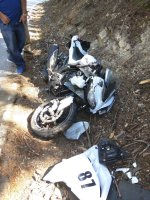
After I stopped, I stood up, looked at my bike laying in the middle of the lane. I saw fluids dripping all over the bike. I approached the bike, turned of ignition key, and went off pavement, knees shaking, no pain, just the realization that I've crashed, my buddy is far up ahead on the road, I've ruined his Sunday ride, and there is my bike on the road. Front wheel was misaligned with handlebars.
A car that I've passed a minute ago approached, stopped. Two gentlemen asked if I'm OK, and helped me to get bike of the pavement. As I pulled its front wheel I've realized two things: the wheel is not really connected to the bike, and my shoulder really hurts. A couple cyclists stopped at the scene, one of them went to a fire station up south.
Firefighters came, checked me out. CHP came, checked me and the bike out.
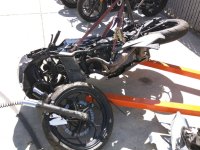
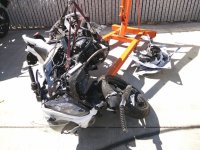
Bike was a mess, and I was lucky to tell everyone that I was completly OK (except for the pain in my shoulder, I couldn't really lift my straight hand to the chest level, but they didn't need to know about it -- last thing I wanted was to go to a hospital).
Good thing I had not an expensive bike - stock, new, 2013 ninja 300. Overcharged for maintenance, overcharfed for destination and assembly fees. No abs. My first bike. Could've been the last...
Its parts were scattered for good twenty meters (60 feet)... Although some plastic I found wasn't mine - there were a lot of plastics from cars.
I could not believe that happened to me after 2 years of almost daily commutes (10 miles on 101 and back, one 35mph turn on a ramp), 3 track days at Laguna seca, planted a knee on a kart-track at a cornering school. And about 3-4 months break in riding just before the incident.
I've investigated my leathers for damage - none found. Alpine stars jacket and track pants did well. Dianese back protector with scapula blades, tailbone, and a waist belt did well. Dianese racing gloves did well. One of them tore at a place where sharp part of plastic reinforcement has cut through the leather because of prior use, but there was a second layer of leather underneath (I wanted to get a warranty repair on that, but was too lazy to go to D-Store in SF). D-air boots did well too. Shoei RF-1100 did well. Lost top-left vent cover. The heavily scratched visor gave me pictures of my faces left on the asphalt. I'm happy I had a full face helmet. Other than damaged helmet, torn glove, minor damage on a boot, and some dirt on the jacket - everything was fine.
I couldn't derive much of what happened by looking at the gear. I was sliding on my left wrist, and on my face. I hit dirt with my right shoulder. I hit dirt with top-left side of my helmet. That's about as far as it goes.
So, what did I do wrong?
- I was riding at speed beyond my comfort level on an unfamiliar road (overly confident).
- I've fixated on the white line instead of actually making the turn.
What did I do right?
- Used full gear.
I was traveling northbound on CA35, not far from CA9 (google maps link)... Lovely Sunday morning... First time on this road.
After negotiating a left and a right turn, I saw a white line approaching my front wheel from my right...
I knew I was going uncomfortably fast.
Slowly but steady the white line was getting closer, and closer, and closer... Until I went of pavement, experienced a crazy wobble, and the world became an one smudged oil painting being waved in front of me quicker than I could register what's on it. All I knew was that I'm crashing, that the sharp pain in my right shoulder probably means I've dislocated my shoulder (again), and that I was still moving.
After I stopped, I stood up, looked at my bike laying in the middle of the lane. I saw fluids dripping all over the bike. I approached the bike, turned of ignition key, and went off pavement, knees shaking, no pain, just the realization that I've crashed, my buddy is far up ahead on the road, I've ruined his Sunday ride, and there is my bike on the road. Front wheel was misaligned with handlebars.
A car that I've passed a minute ago approached, stopped. Two gentlemen asked if I'm OK, and helped me to get bike of the pavement. As I pulled its front wheel I've realized two things: the wheel is not really connected to the bike, and my shoulder really hurts. A couple cyclists stopped at the scene, one of them went to a fire station up south.
Firefighters came, checked me out. CHP came, checked me and the bike out.
Bike was a mess, and I was lucky to tell everyone that I was completly OK (except for the pain in my shoulder, I couldn't really lift my straight hand to the chest level, but they didn't need to know about it -- last thing I wanted was to go to a hospital).
Good thing I had not an expensive bike - stock, new, 2013 ninja 300. Overcharged for maintenance, overcharfed for destination and assembly fees. No abs. My first bike. Could've been the last...
Its parts were scattered for good twenty meters (60 feet)... Although some plastic I found wasn't mine - there were a lot of plastics from cars.
I could not believe that happened to me after 2 years of almost daily commutes (10 miles on 101 and back, one 35mph turn on a ramp), 3 track days at Laguna seca, planted a knee on a kart-track at a cornering school. And about 3-4 months break in riding just before the incident.
I've investigated my leathers for damage - none found. Alpine stars jacket and track pants did well. Dianese back protector with scapula blades, tailbone, and a waist belt did well. Dianese racing gloves did well. One of them tore at a place where sharp part of plastic reinforcement has cut through the leather because of prior use, but there was a second layer of leather underneath (I wanted to get a warranty repair on that, but was too lazy to go to D-Store in SF). D-air boots did well too. Shoei RF-1100 did well. Lost top-left vent cover. The heavily scratched visor gave me pictures of my faces left on the asphalt. I'm happy I had a full face helmet. Other than damaged helmet, torn glove, minor damage on a boot, and some dirt on the jacket - everything was fine.
I couldn't derive much of what happened by looking at the gear. I was sliding on my left wrist, and on my face. I hit dirt with my right shoulder. I hit dirt with top-left side of my helmet. That's about as far as it goes.
So, what did I do wrong?
- I was riding at speed beyond my comfort level on an unfamiliar road (overly confident).
- I've fixated on the white line instead of actually making the turn.
What did I do right?
- Used full gear.
Last edited:





 for wearing the right gear.


