• There has been a recent cluster of spammers accessing BARFer accounts and posting spam. To safeguard your account, please consider changing your password. It would be even better to take the additional step of enabling 2 Factor Authentication (2FA) on your BARF account. Read more here.

5w30 oil weight chart confusion

KooLaid

Hippocritapotamus
Joined
Dec 2, 2007
Location
Flat wasteland
Moto(s)
2020 300 XC-W TPI
Application: Onan Quietset 4k generator

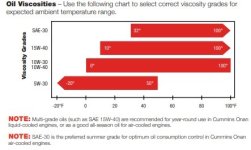
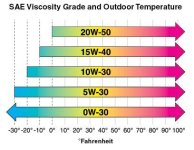
I've always referred to the top diagram (and similiar, this one from amsoil) for my understanding of temp vs oil weight. However in my Onan manual, they refer to the lower one.

I WANT to run Rotella T6 5w30 full synthetic since it's the oil I run in my truck and most all 4 stroke motos, my pressure washer, etc. One weight, one oil to basically run in them all. However onan for 5w30 has an odd temp range for that weight.... I don't understand why the massive difference from
one to the other.......

From Amsoil
attachment.php


From Onan
attachment.php
 

Attachments

  • Untitled.jpg
    Untitled.jpg
    54.8 KB · Views: 326
  • Untitled1.jpg
    Untitled1.jpg
    23.2 KB · Views: 344
Seems way off. Only thing I can think of is this Onan generator runs at a very high normal operating temperature for the oil.
 
My curiosity is why I question it. I can't find anything so far as to why it is presented the way it is.

it is definitely an air cooled motor that runs at one single rpm and designed to do so for hours on end from below sea level to 10k+ feet. From freezing temps to 120+ summer heat
 
Last edited:
Perhaps since it’s air cooled, it will run hotter than if it were liquid cooled which maybe why they want the thicker oil for normal climate. Like a Harley.
 
5-30 isn't any thicker than 10-30 once it warms up, I suspect typo.
 
Out of curiosity, I spent a little time with Google to see if anyone had a plausible sounding reason to use the straight 30.

Surprisingly, there is. Of course... oil threads... you know how those go.

So here's what I saw.
First, I noticed in your pictures that Onan recommends the straight 30 for oil consumption control reasons. It doesn't state there's a lubrication issue.

There are a few people who say they've seen less consumption with straight 30, and others who say they saw no difference.

There's some interesting talk about the additive packages that allow the multi-weight performance. The talk centers around how those additives can seem to break down quicker at the higher temps that air cooled engines generate.

Some of that talk is that while all 30wt and multis may be the same viscosity AT the certifying temp, the viscosity curve/ramp may end with the multi being thinner at the higher air cooled temp. There's a fair amount of talk about the shear properties.

Here's one quote of note.
I think the primary difference and reason hot weather OPE often calls for SAE 30 is viscosity. Your basic Dino SAE 30 is much thicker than the ILSAC 30s usually HTHS of 3.5-3.6 vs 3.0-3.1. When your oil temp is 260 on a hot summer day this matters. The multi-grade HDEO show the same thing, and often have more additives vs your "resource conserving" oils. This really becomes apparent with generators running long periods in summer with high loads. The people that don't pay attention to the oil level running a ILSAC lube don't have a generator very long. The folks that run SAE 30 or 15w-40, 5w-40, 20w-50, 15w-50 and SAE 40 don't have problems with oil related engine failures. Often they don't have consumption issues either.

The part that says,
"The people that don't pay attention to the oil level running a ILSAC lube don't have a generator very long"
is what catches my attention.

So basically, it looks like you could probably use any of the oils you're thinking about, and they'll offer proper lubrication... But some may burn away a bit faster than others. So it'll be up to you to determine if your oil choice will work for the long run.
 
Last edited:
Everything ive read is that the downside to multigrade oils is they break down easier, historically anyways. They're also a lot better than they used to be. That being said, I don't think it's ever been the case that a 5w30 starts having protection issues at 50 degrees while a 10w30 gives you protection to 100. The chart is off, period. 99% of engine wear occurs during startup iirc, which the multigrade does a whole lot better at protecting than a straight weight. there's almost 0 good reason not to run a multigrade. It's a generator, not a racing engine, run the 5w30 and keep an eye on the oil level. Like you should with ANY engine.
 
I sent them a message asking about the oddball chart for 5w30, hopefully I get an answer. It's just very strange.......

5-30 isn't any thicker than 10-30 once it warms up, I suspect typo.

That's I assumed too but digging up OLD manuals from their generators in the 80s like the emerald 1 to my current generation microquiet, it shows the very same chart even 20-30 years ago with 5w-30 being an odd ball.
 
Last edited:
ahhhhh screw it. Dino 30 weight it is. Seems very archaic

I bet its non detergent too..:laughing

O and dont forget the year of rating!..:laughing
 

Attachments

  • Screenshot_20211219-104432_Chrome.jpg
    Screenshot_20211219-104432_Chrome.jpg
    78.1 KB · Views: 64
Last edited:
There are a few people who say they've seen less consumption with straight 30, and others who say they saw no difference.

There's some interesting talk about the additive packages that allow the multi-weight performance. The talk centers around how those additives can seem to break down quicker at the higher temps that air cooled engines generate.

Good research.

I really think Onan is trying to protect their customers from themselves. People are notoriously lazy when it comes to maintaining equipment.

A oil designed to be thinner before reaching operating temp could find it's way past the piston rings causing higher consumption when run in warmer weather. If a user ignores periodically checking the oil level the generator is not long for this world.

Also since the motor is air cooled its operating temp will go up as the ambient
temperature rises. Friction modifiers can break down at higher temps possibly causing the oil viscosity to be lowered. Again if you regularly change the oil this is a non issue, but for generators that live neglected lives...
 
attachment.php


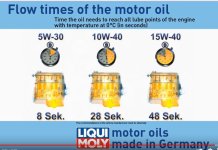
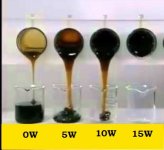
Numbers 30 and 40 are actual viscosity flow grades... whereas 30 will flow
quicker than 40 during cold start and during operating temp... advantage 30...

5W 10W 15W are not viscosity flow grades because oil don't flow much at
minus degrees rather the W is a API test where a cup of oil is stabilized to
minus degrees and then stirred by a precision motor / magnet and the amount
of milli amps it takes to move it in the oil are recorded and compared to a chart... Advantage 5W...
 

Attachments

  • OilFlowTest1.JPG
    OilFlowTest1.JPG
    74.2 KB · Views: 72
  • UsedOilFlowTest5.jpg
    UsedOilFlowTest5.jpg
    29.2 KB · Views: 55
Last edited:
So Cummins Onan sent me a response last week.... In very very similiar words, if not dead on since I don't have access to that email at this moment:

Onan Engineers specified the oil weights for a reason. Stay with the specifications.

Don't we have a barfer whose dad is an engineer???
 
Last edited:
You're way over thinking this lol.

Wifes subi started burning oil around year ago now. Probably longer, but only now to the point where it's burning enough for low oil light to come on before the oil change which is how we caught it. Manual calls for 0w20. Been putting a mix of 10w30, 10w40 since then. Hasn't blown up yet. Who knew?
 
You're way over thinking this lol.

Wifes subi started burning oil around year ago now. Probably longer, but only now to the point where it's burning enough for low oil light to come on before the oil change which is how we caught it. Manual calls for 0w20. Been putting a mix of 10w30, 10w40 since then. Hasn't blown up yet. Who knew?

But the subi has an oil light that allowed you a chance to add oil right? Would your engine still be good if you didn't add any oil? That's what we're talking about. Any oil will protect just fine, as long as there's still oil in the sump. Onan, and others, have determined that certain oils get consumed faster than others.

Like you said, there's no reason to overthink it. But there's no reason to ignore it either.
 
Back
Top